Building a Source-Verified
AI Learning Workflow
AI-Assisted Learning Design | Technical Documentation, Microlearning, Verification, and Human Review
I wanted to test how generative AI could accelerate learning development without sacrificing source accuracy or human oversight. AI-created content still needs to remain accurate, grounded in authoritative sources, appropriate for the learner, and subject to human judgment. The workflow separated content generation from source verification and ended with human review before publication.
What the Verification Caught
The Verifier Agent received both the original Word Finder source and the generated lesson.
Its instructions were different from the Draft Agent's:
Compare the draft against the authoritative source. Flag anything inaccurate, unsupported, broader or narrower than the source, or invented. Do not rewrite the lesson.
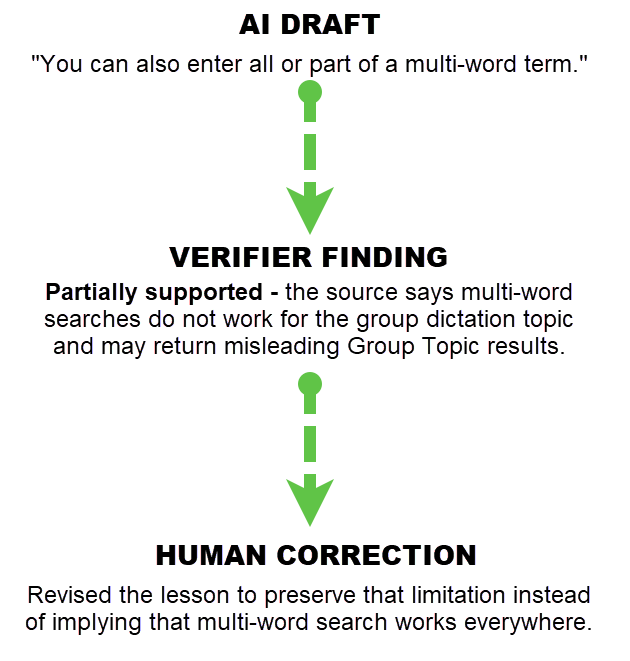
Most of the generated content was verified as accurate, but the verifier identified one important over-generalization: the technical source does allow multi-word searching in Word Finder, but it documents an important exception which is that multi-word searches do not work for the group dictation topic and may produce misleading Group Topic results.
The generated sentence was technically based on the source, but it removed a qualification that could matter to the learner.
The verifier also identified several areas where the draft was accurate but intentionally simplified. I kept those details out because the asset was designed as a short microlearning, not a replacement for the full technical reference.
Those were not treated as errors because the learning asset was intentionally scoped as a short microlearning rather than a replacement for the full technical reference.

The Challenge
Generative AI can quickly turn technical documentation into learning content, but speed alone is not enough. When AI summarizes or transforms technical information, it can simplify too aggressively, broaden a claim beyond what the source supports, omit an important qualification, or introduce product behavior that was never documented.
I wanted to test a lightweight workflow that could help reduce those risks while still taking advantage of AI-assisted content development. For this prototype, I used the nVoq Administrator Help article for Word Finder as the authoritative source. Word Finder is an administrator troubleshooting tool used to locate the source of unwanted or misspelled words appearing in dictation transcripts.
My Role & Approach
I designed a simple four-stage workflow:
Source of Truth → Draft Agent → Verifier Agent → Human Review
The Draft Agent could create learning content, but it was instructed to use only the supplied technical source and not invent product behavior.
The Verifier Agent had a different role: compare the generated lesson back to the authoritative documentation and identify anything inaccurate, unsupported, overly broad, overly narrow, or invented.
The final decision remained with me.
The Source of Truth
The existing nVoq Administrator Help — Word Finder article served as the authoritative source for the workflow. AI-generated content was required to remain grounded in the documented steps, terminology, and known limitations.
Draft Agent
I gave the Draft Agent a concise set of instructions:
Use only the provided source as the source of truth. Create a short microlearning lesson with 3–5 steps, one limitation, and one scenario-based knowledge check. Do not invent product behavior.
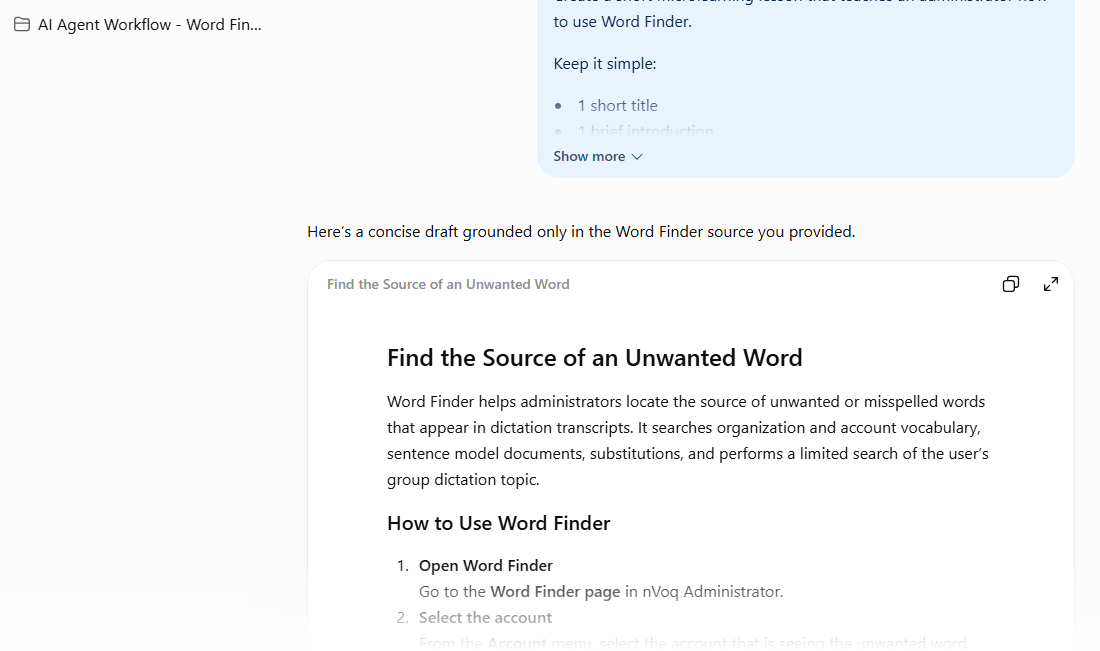
The agent produced a short administrator-focused lesson, Find the Source of an Unwanted Word.
Human Review
The final step was human review. I agreed with the verifier's finding about multi-word searching and revised the lesson so that the limitation was preserved rather than implying that multi-word searches work consistently across all Word Finder search locations. I also reviewed the remaining verifier findings to determine whether additional detail would improve the learning experience or simply add unnecessary complexity.
The final decision was: Approved with one required edit.
The verifier was not given authority to publish or automatically rewrite the content; its role was to surface potential problems. The final instructional and editorial judgment remained human.
Why the Workflow Matters
The workflow separates three different responsibilities:
Generation creates the initial learning asset.
Verification checks the content against the authoritative source.
Human Review determines whether the material is accurate, appropriately scoped, and ready to publish.
That separation reduces the risk of AI-generated content validating itself and keeps final judgment with the human reviewer.
Testing the Workflow Across Multiple Topics
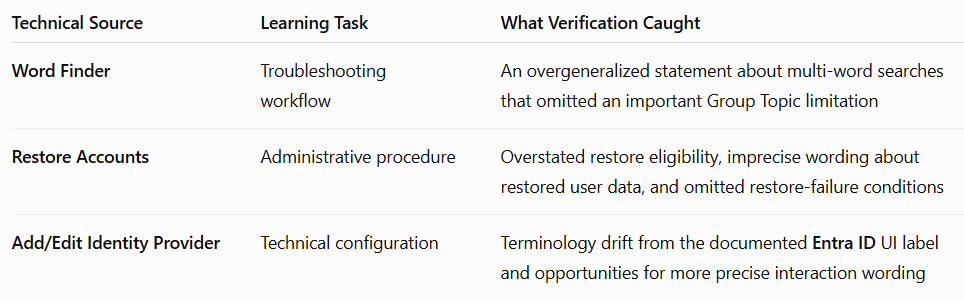
To test whether the workflow was repeatable, I applied the same Draft Agent → Verifier Agent → Human Review process to three different administrator learning tasks.
I reused the same generation instructions, verification criteria, and human-review approach rather than designing a new process for each topic. Each source represented a different type of technical learning task and produced a different kind of verification finding.
What This Demonstrated
Using the same workflow across different types of technical content showed that the process was not dependent on a single topic or source structure. The standardized generation, verification, and human-review stages could be reused while still identifying different kinds of content risks—from missing qualifications to terminology drift and incomplete procedural constraints.
This prototype demonstrates a repeatable production pattern designed for larger content sets. In a larger implementation, the same standardized workflow could be applied across multiple source documents and learning assets while maintaining consistent source-grounding and review criteria.
Tools & Platforms
ChatGPT • Microsoft Word • nVoq Administrator Help / Document360
What This Project Demonstrates
AI-assisted learning content development
Source-grounded generation and verification
Reusable, multi-stage AI learning workflow design
Technical content validation
Microlearning and scenario-based assessment
Human-in-the-loop quality review
Translating technical documentation into customer education
“The goal was not to let AI create training on its own. It was to design a workflow in which AI could accelerate production while authoritative sources and human judgment remained in control.”